Mona Lisa Panel
The corners of the Mona Lisa panel were protected by old paper that had been pasted on it after 1939, but that paper has now been peeled off, allowing the hidden parts to be directly observed.
The color of the panel has turned dark brown due to aging on the surface, but it is clear that it was originally a lighter brown. Saw marks are quite clearly visible on the top and bottom edges of the panel. There are also many traces of parasite holes on the outer perimeter and back of the panel.
The outer perimeter of this panel was cut at the unprimed wood, and the drawing layer was not cut. There was a time when it was believed that the columns on both sides of the Mona Lisa painting had been cut off in the past, but in fact the columns were painted up to the edge of the base inside the cut surface.
The current width of the panel is 53.3 cm at the top and 53.4 cm at the bottom, and the height of the panel is 79.2 cm on the right side, 79.1 cm on the left side, and 79.4 cm in the center.
The unpainted border around the panel is used to insert the panel into the original frame.

 The Mona Lisa panel was taken from the flat grain of a poplar trunk sawn lengthwise.
Poplar is common in Italy and is often used in Italian painting. The grain shows fairly faint growth rings running vertically. These are clearly visible on the left half of the back of the panel.
Panels cut 500 years ago are not as uniform in thickness as modern ones. Recent research has shown the panel to be between 12.4mm and 13.8mm thick.
Across the width, in the lower two-thirds, the centre is thicker than the edges, while in the upper third the relationship is reversed, with the centre being thinner than the edges, especially towards the top end.


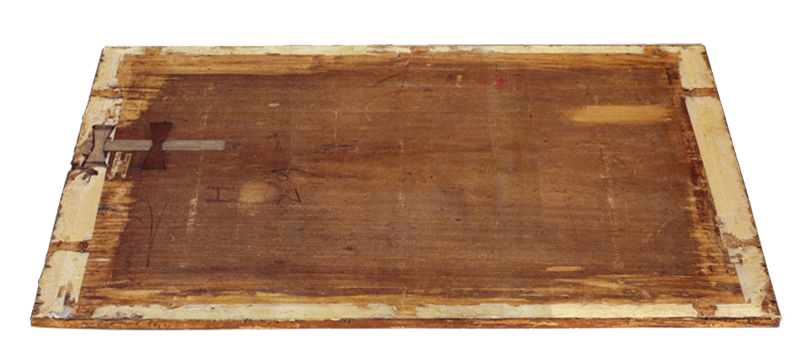
The vertical crack in Mona Lisa's head is reinforced by two butterfly-shaped wooden pieces on the back, and reinforcement material is attached to the top of the panel to prevent the crack from spreading any further.
In Japan, there are not many opportunities to see paintings on wooden boards, so they are not very familiar.
However, many paintings exhibited at famous art museums overseas are painted on boards, and the quality and quantity are astonishing. Especially large altarpieces are quite intimidating even when viewed from the front, but when you go around to the back, you are overwhelmed by the imposing reinforcement material. It looks more like a building than a painting, and has a considerable weight.
There is no accurate data on how much the Mona Lisa panel weighs, but if you calculate the specific gravity of poplar at 0.45,
79 x 53 x 1.3 x 0.45 = 2449, which is about 2500g.
Panel Outer Detail
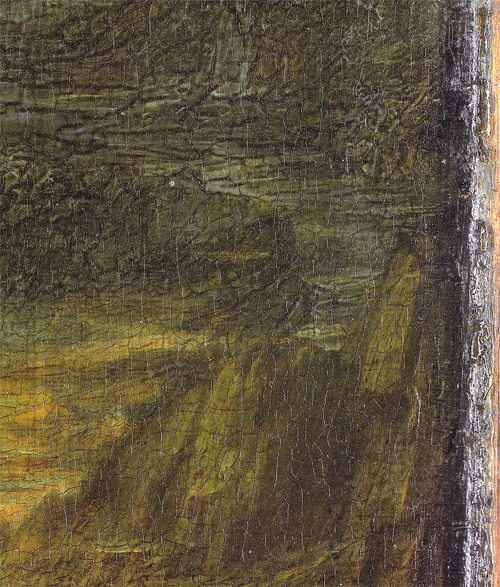
Left image - Close-up of the right edge of the screen
Unlike the fine surface of the screen, the base at the edge of the panel is rough and raised, and in some places the panel underneath is visible, giving it a rather rough feel.
The base is painted only up to just before the cut edge, and the depiction of the pillar does not reach the cut edge.
The condition of the outer periphery of the panel suggests that the Mona Lisa was always displayed in a frame during production.
Back of the panel
In the case of panel paintings, the panel has a tendency to warp toward the rear where there is no painting.
For this reason, measures have been taken to prevent the warping of the panel from progressing by reinforcing it with oak wood and managing the air conditioning.
Regarding cracks, there is a vertical crack in the Mona Lisa's head that is clearly visible from the front. Two butterfly-shaped wooden parts have been inserted from the back of the panel to prevent it from cracking further. In addition, a canvas-like cloth has been pasted on the back of the vertical crack to reinforce it.
The image below shows the panel without the frame to reinforce it. The frame is made of oak and is attached to the outer perimeter of the panel like a picture frame. Furthermore, four horizontal bars are placed from there to support the panel. The type of horizontal bar has been changed several times, and it is currently made of sycamore wood.
The area where the thickness of the back of the panel has been slightly shaved along the outer perimeter of the board to make it thinner shows the wood before it turned brown.


leonardoresearch.jp